
This article is part one of a three part series about Twisp Town Council passing two proclamations at their meeting on May 13 and its subsequent ramifications. The first article deals with passage of a proclamation supporting fire service employees, the text of which can be found here.
The Twisp Council Meeting May 13 could have come out of a Monty Python skit.
On the agenda that night were two proclamations in opposition to policies from the White House. The first, proposed by Dwight Filer, was a request that the administration immediately reinstate all laid off U.S. Forest Service employees and ask that the presidential administration confer with federal, state, and local agencies prior to any future dismissals.
The second, proposed by Kathleen Manseau, asked the Town of Twisp to affirm their support for constitutional protections with regard to all persons in the country, whether they are legal residents or not.
Mayor Hans Smith suggested the council use criteria to evaluate the merit of the requests, in line with other towns and cities that have developed their own criteria. After lengthy discussion, the council did not vote on the criteria and turned their attention to the proclamations’ presenters, without opportunity for real time public feedback.
What followed was a back and forth about the merits of the proclamations, one council member saying she hadn’t had time to read them, one council member tuning in remotely, and at the conclusion of the discussion, confusion about what they were voting for.
This article deals with the first proclamation involving Forest Service employees.
Council Split on Proclamation Guidelines
Smith’s own criteria for discussing proclamations, which he presented to the council, included impact to the town, likelihood of it having a positive effect, its level of divisiveness, and whether the town has all the facts and information to make a statement about it or enact a policy.
“I’m not making a case that any of these discussions are a waste of time, but we certainly set a precedent when we accept requests for proclamations that we would potentially be spending a lot of time entertaining proclamation requests if we don’t have some good guidance on what constitutes a matter that we’re willing to deliberate on,” said Smith.
The full council did not agree on the mayor’s criteria. Council members Katrina Auburn and Tim Matsui said they appreciated having some form of criteria, but council member Will Menzies said the guidelines could be broadened in light of people looking for reassurances from their elected leaders.
“It feels cold to me to have people looking to their elected leaders for specific reassurances and because it doesn’t fit in our guidelies, we tell them no,” said Menzies. “I think there’s got to be some kind of wiggle room in that.”
Matsui supported guidelines and also suggested a higher calling for the town council.
“Is the town here for water, sewer, roads, police, and that’s it, or is the town here for something greater, which is a messaging thing saying our constituents are interested in this?” asked Matsui.
“I think we need to think beyond just our presence here in the town of Twisp and think, what is our role in the valley, in the county, in the state, and the nation when we talk about the scaffold for good governments and democracy,” he added.
Council member Wyatt Lundquist, who is not running for re-election this year, citing time requirements on the council and a desire to spend more time with his young family, expressed concern about the divisive nature of the proclamations and advocated for personal conversations.
“To sit here and discuss these things, we could, and we would be here a long time, and I think we already give enough of our lives to some of these council meetings sometimes, which is part of the reason why I can’t do it,” he said.
“I have a lot of my own personal opinions on political issues, but I don’t necessarily think that’s an appropriate thing for me to bring in as mayor,” said Smith. He said that if the council doesn’t like his criteria, it can override him by having two council members make a motion for discussion.
“I believe that as elected officials, we’re not here to solve what’s happening in Congress, in the federal executive or even the state legislature,” added Smith. “We’re here to handle what’s happening in the town of Twisp in the business that we’re accountable for.”
Menzies said proclamations can be performative, but they can be significant in terms of making the public feel better and holding the council accountable.
With all council members agreeing to some form of guideliness, none were voted on, and the council proceeded to hear from Filer.
Frustration With Twisp Council Debates
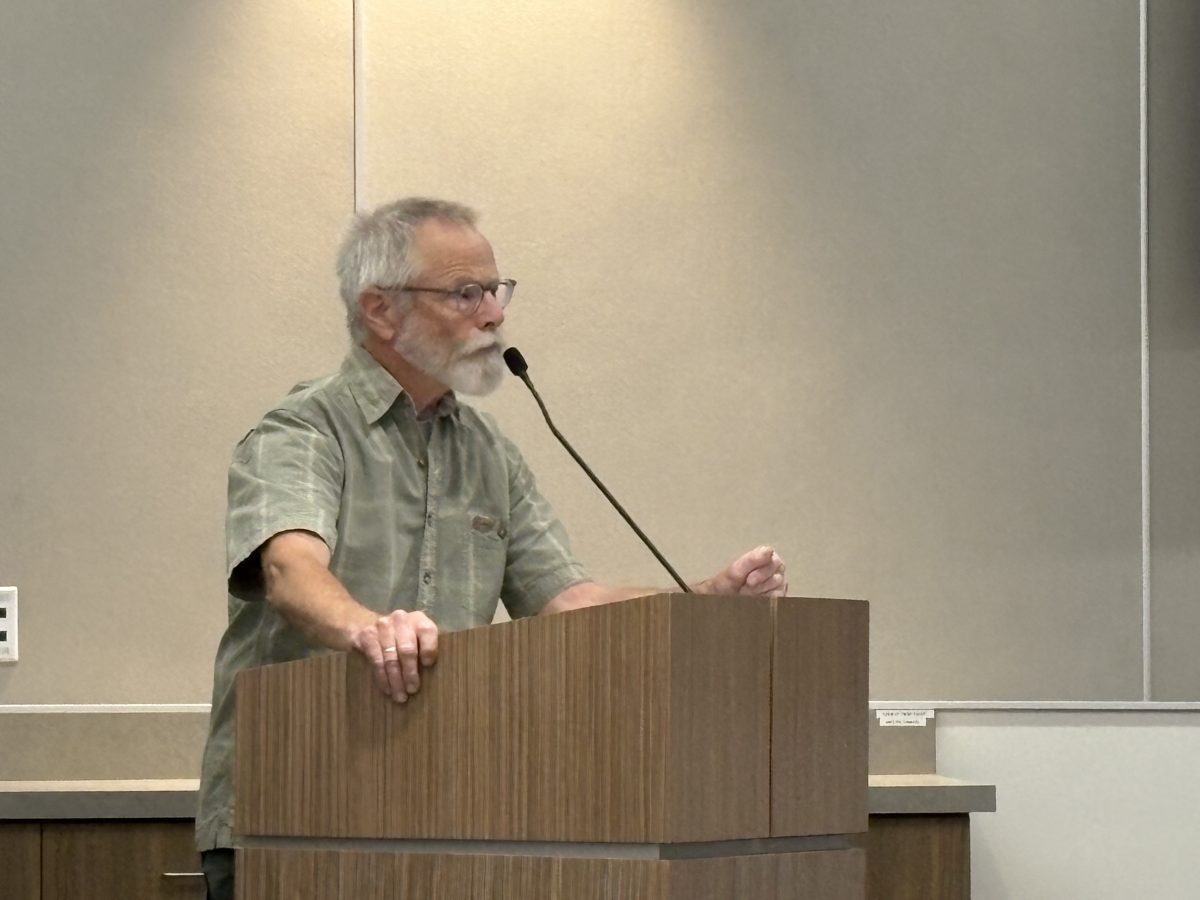
Filer spoke passionately about a friend being fired for alleged unsatisfactory performance, although his performance reviews, which he held in his hand while speaking, showed otherwise.
“What we’re asking you to support tonight is a much broader issue than just the firefighting issue,” said Filer.
Filer expressed frustration that the Twisp Town Council did not act quickly and unanimously to support the resolution compared to Winthrop Town Council, which spent five minutes on it and approved it unanimously.
“I’m skeptical whether it’ll create that impact. That’s part of my reticence. It’s not necessarily that I disagree with…,” said Smith.
“That’s a judgment call,” interjected Filer.
“I agree,” responded Smith. “I’m telling you my judgment.”
“Regardless of proclamation or no proclamation, the concern is understood and registered, and I’m going to continue to communicate with our county partners and the federal partners about our fire preparedness,” said Smith.
Matsui said the proclamation could have been written better, but voted for it anyway.
“I feel this is an incomplete proclamation, and at the same time, I would support it, because I think, are we the scaffold? Are we part of the scaffold that says this branch of government, that we are paying for, is not providing us the service that they are actually mandated to provide. My customer service review is going to be, that’s not good. I want more,” said Matsui.
“I agree this is not a perfect resolution,” responded Filer. “We had 50 people telling us, ‘Oh, you need to change this or add that. We just had to come up with one. It’s not perfect because I’m not perfect, and the people that help me write it are not perfect.”
Filer then targeted his frustration at the mayor.
“I have to say, I’m disappointed, especially with you, Hans, tonight. It seems you’re twisting yourself in pretzels to try to avoid helping us pass this simple resolution onto Dan Newhouse. We haven’t been able to get through to him. We’re asking our local representative now to try to get through to him as our federal representative. It’s a simple request,” said Filer.
“When you have a friend that was dismissed, and I don’t know how many of the council members have read the two documents I submitted here, read it verbatim, read every single word of it, every single word means something, and that’s why I’m making the point that this is a broader issue than firefighting, Hans, and I came here hoping that you would show some leadership and encourage your council to pass it.”
Council member Menzies expressed his strong support for the resolution.
“Quite frankly, none of these seem edgy to me. It seems like we’re just injected with politicizing everything when we’re talking about loss of jobs directly in our community that will directly affect our community, followed by, like, if we believe in the Constitution. It seems wild that we’re at this point,” he said.
Council member Lundquist said he understood the issue differently after council’s discussion about terminated employees.
“I’m trying not to get a little emotional here, go down a rabbit trail that doesn’t really need to be gone down, so I move to pass the resolution,” he said.
Matsui seconded the motion. Upon further discussion, council member Aaron Studen, who participated by phone, said, “I just want to say that I do agree with the mayor’s statement that the resoution probably isn’t going to have much effect, but I do feel what we’re asking for is in the best interest of our constituents and the people of Twisp and the people of the valley and as far as fire resilience, I would be in favor of passing the resolution.”
At the conclusion of the debate, Mayor Smith said the resolution wasn’t in correct form and he would bring it back to the council for final approval. Smith asked the council whether the text would be a resolution or proclamation.
“Aren’t we looking at a proclamation that we’re passing currently?” asked Menzies.
“It’s a resolution, not in resolution form,” said Smith.
The chamber fell silent.
Auburn broke the silence by asking the mayor for more time to consider the resolution. Matsui said the council had previously authorized the mayor to make formatting changes and asked why the resolution couldn’t be passed as is. Menzies asked why the resolution is in incorrect form in the council’s packet.
“Well, it’s here for discussion,” said the mayor.
“It’s under discussion and action, but we’re not actually capable of making an action on it,” said Menzies.
“I think we’re going down a road we don’t really need to be on here,” chimed Lundquist.
Menzies questioned what was happening.
“We’ve got someone that has made [a motion] to pass it. We’ve got a second. We have yet to call for a vote. What are we…? I don’t understand why, how….”
“I’m just asking for guidance,” said the mayor, “because typically a resolution is adopted in its form and this is not written in the town’s form.”
“Could we take this language and put it into the appropriate form or format and not be in any legal jeopardy?” asked Matsui.
“It’s not typically what we do, but I don’t think that it’s going to be a major issue,” said Smith. “If you just want this verbatim pasted into our form, I’m sure we can do that.”
“I’d kind of go with that,” said Lundquist.
“I’m good with that,” said Matsui.
“For sure, we’re good with that,” said Menzies.
With that, the resolution passed 4-1 with Auburn abstaining because she hadn’t read it.


