
|
Getting your Trinity Audio player ready...
|
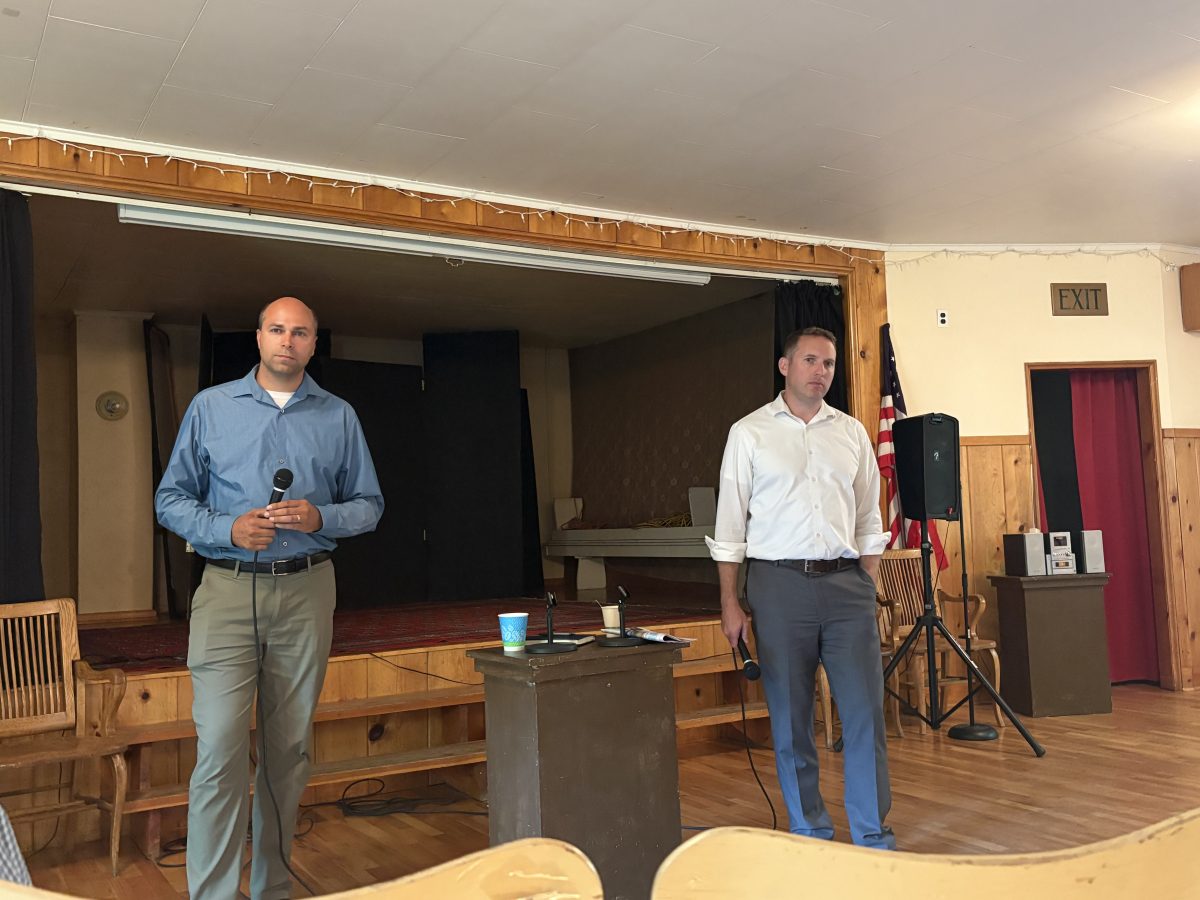
State Reps. Andrew Engell and Hunter Abell faced a slurry of questions, some about national issues, at a town hall in the Twisp Valley Grange July 17. Each representative took questions from the left and right side of the room.
Engell serves on the Agriculture and Natural Resources, Healthcare and Wellness, and Housing committees in the House. Abell serves on the Civil Rights and Judiciary, Rules, and Military Veterans Affairs committees.
While there are 49 legislative districts in the state, the 7th Legislative District makes up 20% of the land mass of Washington.
Here are some highlights from their responses to topics raised by constituents.
Wildfire Risk
ENGELL: “It’s a problem. It does not have a clear solution. We have some fuel reduction programs that have been helpful in a lot of areas. Unfortunately, the legislature made major cuts to those programs this year, so that’s something we’re going to have to look into hopefully in a short session next year. In the meantime, there are other proposals. There are ideas of trying to fully adopt the wildland urban interface code, which would be so costly, my prediciton is that most of the rural areas would not have any more housing constructed unless it’s for very wealthy people, because the cost would be so prohibitive. So we need to look at how we can help existing people become more resiliant to wildfire.”
ABELL: “Just last week, we met with new lands commissioner Upthegrove and his team here in the valley [for] wildfire prevention and response… where he heard repeatedly that wildfire is an existential threat to our small towns and our ranches, our farms, out here. I think he’s getting that. I think he’s asking the right questions. I’m curious to see what it looks like as far as policy decisions out of his office over the course of the coming year but I know we have been articulating that, and maybe even more impoprtant than us, the folks here as well.”

Effect of Medicaid Cuts on Rural Hospitals
ENGELL: “I recently visited all three hospitals in Okanogan County a couple of weeks ago and I’m out meeting with as many of the healthcare folks as I can. There’s a lot of uncertainty right now, especialy around Medicaid changes in the federal policy bill. We’re still waiting to see what it’s exactly going to look like. There’s a lot of uncertainty…. A lot of the hospitals across the 7th District are on the vulnerable list because Medicaid pays only a fraction of the cost of actually providing care to the people, and a lot of these rural areas have a high Medicaid population.”
“The requirements for these hospitals to have a lot of expensive equipment and staff there, and if they get less use because there’s less people to use them, it’s harder to pay for this expensive equipment. So, there are a lot of challenges to them, but as far as Medicaid, we’re waiting to see. We cannot let these hospitals go bankrupt or let them close. It’s essential for everyone who lives in these communities to have access to lifesaving care when you need it. The state legislature will certainly be acting to protect the hospitals, however we need to do it, but right now, we’re really kind of waiting to see. Most of the provisions of the bill won’t go into effect for a year and a half, so I’m relatively confident that we’ll be able to do whatever we need to do to keep them solid.”
Engell said he is not opposed to work or volunteer requirements in principle, but he underscored the reality that some people are not going to be able to jump through bureaucratic hoops to keep their health insurance.
ABELL: “I think there’s broad bipartisan support for assuring that rural hospitals are protecting and stengthened in the course of the forseeable medium and long term future. It also tees up questions. One is the piece on resources and two is the pipeline for bringing medical professionals into rural areas, in particular doctors and nurses. This continues to be an ongoing problem.”
Priorities for 7th Legislative District
ENGELL: “Housing crisis is severe across our whole state. The state is last in the nation when it comes to housing units per capita, and we need to address that. In the housing committee, there are lots of bills that are addressing it to some degree, but unfortunately, most of it is addressing housing in urban areas, and so it’s something I’m trying to advocate for is rural options. One of the things I’m working on is a policy that I can try to get some bipartisan support for is to create some exemptions for entry-level homes. Some of these regulations have added a lot of costs and a disproportionate amount of costs to the entry level smaller homes. I’m meeting with Habitat for Humanity and some of these housing nonprofits to try to find support for this idea. So that’s one. We’ve got forest management, is another one.”
Engell talked about meeting with DNR to increase the amount of trees that can be removed on private property from 100 feet of one’s house to within 100 feet of one’s property line, outbuildings and utility lines. He also said he would like to explore proposing a bill to build resiliency in healthcare, but doesn’t know what that will look like yet.
Abell talked about protecting the rural way of life, which includes wildfire prevention and response, insurance availability, economic development and health care. He also talked about increasing the amount of police officers in the state, noting that Washington is last in the nation in per capita law enforcement officers. He also spoke about improving recruitment and hiring of police officers. He introduced a bill that would have provided $100 million to hire more police officers, but another, smaller version made it to the governor’s desk.

Mail-in Voting
Abell said he supports in person voting with absentee ballots for people in particular circumstances. He noted information can change during an election and those that have submitted their ballots cannot change their vote.
“The concept of an election is really important for the community, the state, the country comes together, makes a collective judgment based on the information they have and votes at that time. Right now, with all mail-in approach, we don’t have an election day in Washington. We have an election season,” said Abell.
Engell said mail in voting did not increase turnout in the way they thought. However, returning to in-person voting doesn’t have to return to the way it was before. Accommodations could be made by looking at options in other states.
“What’s concerning to me about some of the proposals to go to all in-person voting is, we want to make sure if we do that, we do it in a way that doesn’t restrict access, because there are a lot of people today who would have a hard time going back to that system, and we have to be committed in a representative democracy to make sure that every vote is countable and nobody is excluded because we’ve made it too difficult. I think we could overcome those things, like going back to partially in-person, but regardless, we have to make sure we maintain good access to voting,” said Engell.
“I don’t see us changing anytime soon how we do our elections. So, to some degree, we’re talking hypothetically,” he added.
Election Integrity
ENGELL: “Of the election systems that I’ve obsesrved and talked to auditors, I generally believe that at least in the areas I’ve been, that our system is working very well, and certainly people have concerns, but the things I’ve seen… they maintain these paper ballots, there’s a chain of custody, and generally, I believe it works well.”
ABELL: “I’ll just say- I think our auditors in the 7th District are outstanding. They do a very good job.”
Take-Aways From Freshman Year
ENGELL: “I was president of my homeowner association. It reminded me a lot more of that than I expected. I think most people will be a little surprised just the human nature that shows itself in those chambers. Most people, they’re all human beings, Ninety-eight human beings that come together, with a lot of similarities to everyone else in this room and us, and they’re framed by the experiences of their own areas, and the constituents that they serve.”
Engell said there is a lot of exaggeration on both sides and he came to realize that it is for clips on social media for likes and shares. It is for show, not necessarily based on fact.
“It works to undermine trust in our system of government. I think when people are exaggerating and sensationalizing things… you have now multiple narratives or two largely segregated ones, but they are certainly not homegenous on the left or the right, and now people don’t know what to believe. I believe a lot of times on the House floor, there are these speeches, you’re not speaking to change anybody in the room’s mind, because they don’t know if you’re telling the truth or not. We need to change that. Both of us are committed to trying to speak what we believe is true and accurate,” said Engell.
“Also, these 98 people, 96 others, besides us two, are all humans, and we can sit down with just about every one of them, regardless of party, and have a rational conversation. You can find common ground on a lot of things. A lot of times they’ll acknowledge a problem that’s happening in our district, but they’ll also say it doesn’t affect their district, and they’re not willing to burn political capital to help us. So, that could be frustrating, but it’s understandable, right? They’re there by the will of their voters, and the will of our voters doesn’t affect them very much. So, if we can find ways to help them make amendments to their bills that will help the people here without hindering the people in their districts, that seems to be the way to success. I feel like there’s actually a lot of hope by working together, learning how to have good, positive dialogue, embrace hard conversations, talk.” he added.
Abell said he counted 900 votes this past legislative session on bills and amendments. He agreed with Engell about the need to speak truthfully and accurately on the House floor. He also talked about educating other legislators about the 7the District.
“The party political system over there was in some sense helpful in the sense the chamber has to be organized in some way, there’s a majority and minority, the place has to operate, and that’s the system that we have. On the other hand, it is kind of discouraging. You gave the example of the homeowners association. Anybody that has been in a minority on a homeowners association knows that can be really difficult. So there’s a little bit of a dynamic like that, but by continuing to respectfully engage in difficult conversations, be able to speak something that’s genuine, something that’s accurate, something that’s new, I found it opened a lot of doors, and it allowed a lot more conversations to take place,” said Abell.

Conducting State Business Over Social Media
Both representatives said state business is still conducted over traditional means, i.e. not leaked in social media.
ENGELL: “One thing that I think is actually a bigger surprise is that there’s very little state policy being discussed anywhere at all. If we look at what affects your life, there were nearly 500 bills that were passed and signed into law this year at the state level. Of course, the state bills are much smaller in scope than the federal bills, but they affect your life. There’s a lot of bills that will affect what you do that you might not even know passed yet. That surprised me more, how little people are paying attention to that. Mostly people are paying attention to what’s happening at the federal level, because that’s what’s on our television. I think it would be better if people could, certainly pay attention to the federal level, but your state, county, and your city, honestly affect your life more and if people just put a little more effort into those, I think we’d have a better state.”
Abell agreed with this statement.
Climate Change
ABELL: “I do believe climate change is happening and I think there are lots of good debates about the extent it’s being caused by mankind, what we can do about it, what we should be able to do about it particularly in light of actions by international actors as well.”
“I support “all of the above” energy policy. I think hydro is part of that answer. I think solar, wind, part of that answer. Fossil fuels are part of that answer as well. Anyone that says they’ve got a silver bullet for climate change, I don’t think is getting the full extent of the debate and the full context.”
ENGELL: “Clearly, the climate is changing and it’s having impacts.” Engell talked about not having smoke-filled summers when he was growing up.
“Just to look at it from just the carbon piece, a lot of what Washington State has done, I believe, has been ineffective and it’s really just made life a lot more expensive. It’s disproportionally impacting lower income and rural people in our state. I believe that if we’re looking at climate policy, we need to be making sure that we’re not doing it on the backs of the people who make our state run…. I have a lot of concerns with a lot of the policies that have happened in the last few years that have made us significantly more expensive place to live and has questionable changes. The company can just move across the border into Idaho and do the exact same thing they were. The same amount of carbon is getting emitted, we just don’t have the jobs here anymore. Some of the things I’d like to see is… resiliency to a changing climate. I think we should be focusing more there,” said Engell.
He talked about focusing on what we can control, like reducing the severity of wildfires, than on things that are questionable in terms of control, such as temperature in the atmosphere. Engell also expressed concern about farmland being taken over by solar panels and causing ecological harm for wildlife in other areas. He voiced support for a variety of energy options.

Immigration
ENGELL: “We have a broken immigration system. I think most people recognize that on both sides of the political aisle. We need to make it easier for people to come here, take these jobs that need to be filled, and take that money and use it to benefit their families and improve their lives. We’ve made it very difficult in America to go through the proper channels, and so a lot of people aren’t. At the same time, we’re a nation of laws…. In their minds, they’re not breaking [the law]. They see it as just what you do. Someone goes, jumps the fence, swims the river, goes and gets a job on a farm, brings back money to their family, has a better life and they tell their brother, hey, this is what you do. And they’re struggling and they do the same thing. It becomes a culture and you get way with it, and it works.”
Engell said law enforcement should be clearly marked as law enforcement.
“This idea of hiding behind masks or taking people without due process, that’s concerning to me. I’m also not involved with that, so I don’t know exactly what’s happening, but those reports, if they’re true, are very concerning to me.”
ABELL: Thanked the constituent for her question.
“It’s kind of interesting, during session, where we were just absolutely immersed in state issues. It kind of felt like we were in a time machine, where we didn’t have any interaction with national issues until we came out… and said, ‘what happend in the country?’ It’s kind of like that because we were dealing almost exclusively with state issues, and that’s a big part of our job is education and talking to individuals about what’s the state role, what’s the federal role.”
Abell said he has been meeting with agricultural leaders who said young people don’t want to go into farming because there are easier ways of making a living.
Sale of Public Land
ABELL: “I’m from Ferry County. Less than 10% of land in Ferry County has a tax base. Ninety percent of it is off the tax roles. That’s a pretty extreme example but that’s not super unique throughout the American West…. I think it’s appropriate at various times for the policymakers at the federal level to determine if this land is used in the most appropriate fashion.”
ENGELL: “Our public lands are a huge value. That’s a lot of the reason people live in the 7th District, because of access to nature, and it’s in our backyards…. I think there could be a discussion to be had in a more rational way about, are there appropriate places that are currently public that are not really used for a lot of public benefit now that would better serve the public if it was used for another purpose. [I’m] not talking about a wide-scale sale, but I think it’s an interesting discussion and it’s one that I think we should have rationally and in a bipartisan way.”
Wealth Inequality
ENGELL: “I’d like to see the size of government shrink. This year, we had record breaking tax increases in Washington State and the majority of those are landing right at the backs of working and lower class people. That’s highly disturbing to me.”
“If we went to an income tax, i don’t trust the current state to roll back something else. I see it as just adding. We do have a regressive tax system. It does bother me. I do talk to other legislators about this issue of constantly trying to increase the amount of taxes that we’re spending. Everywhere we go, people want more money, and I have to remind them, in order to give you more money, we have to take it from someone else, and there’s getting to be less and less people to take it from. I understand the concern. I understand the wealth inequalities in my experience in my life have been that generally, there’s those few people that have figured out how to jump through those hoops really well and typically, not much affects them. Most of these things that are claimed to help low income people actually land on their backs.”
ABELL: “I agree with your observation that it seems like both parties maybe have lost sight of the working class voter, and I am convinced that the party that can articulate a hopeful, pragmatic, realistic vision for working class voters is likely to be the dominant political majority in the forseeable future. I’m interested to see what it looks like as we go into a presidential election in three years and mid-terms next year.”
Abell said he “strongly” opposes a state income tax. He also spoke about the disproportionate effect taxes have on low-income and rural voters, such as the gasoline tax.
“Our lack of a state income tax has been an economic driver for our state, particularly retirees… [it’s] why people have wanted to set up and do business and live here in the State of Washington, so I do not favor an income tax,” he said.


