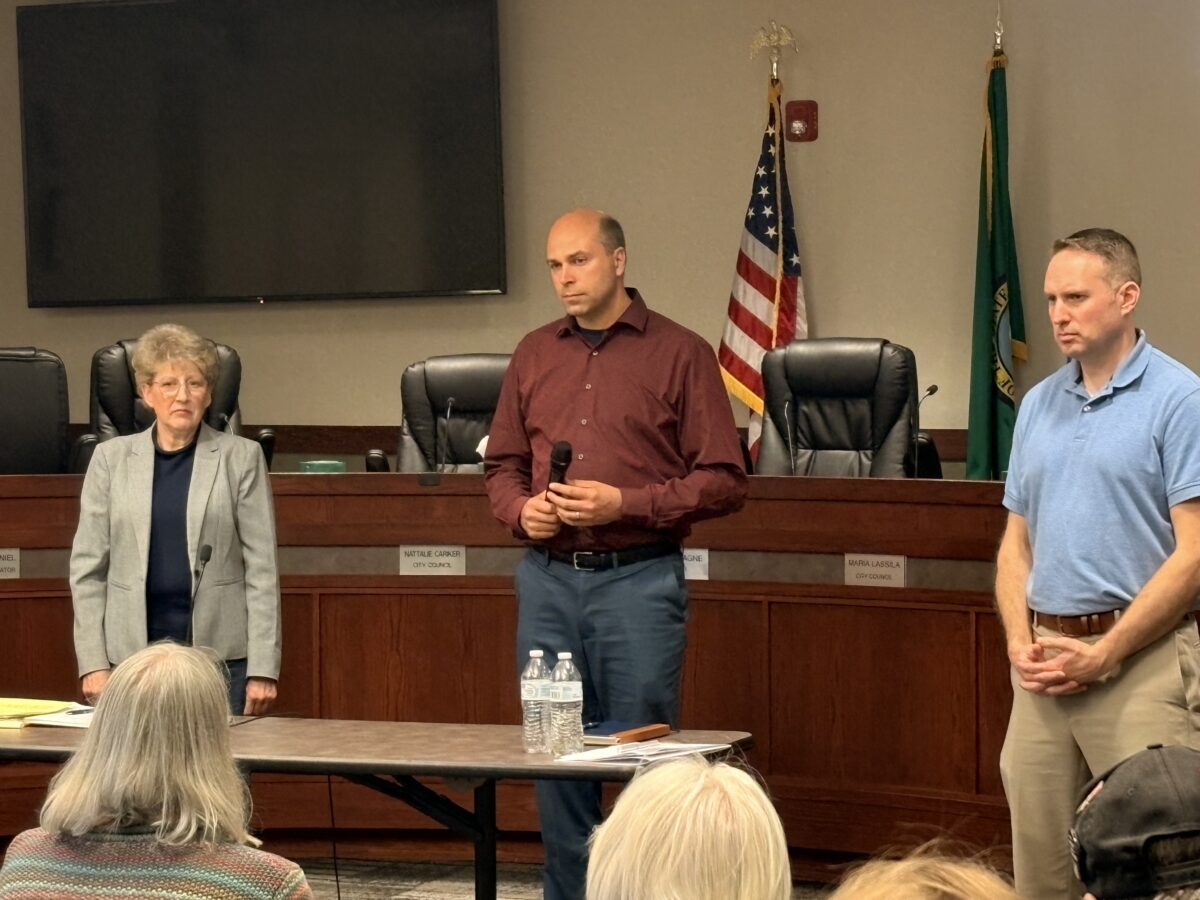
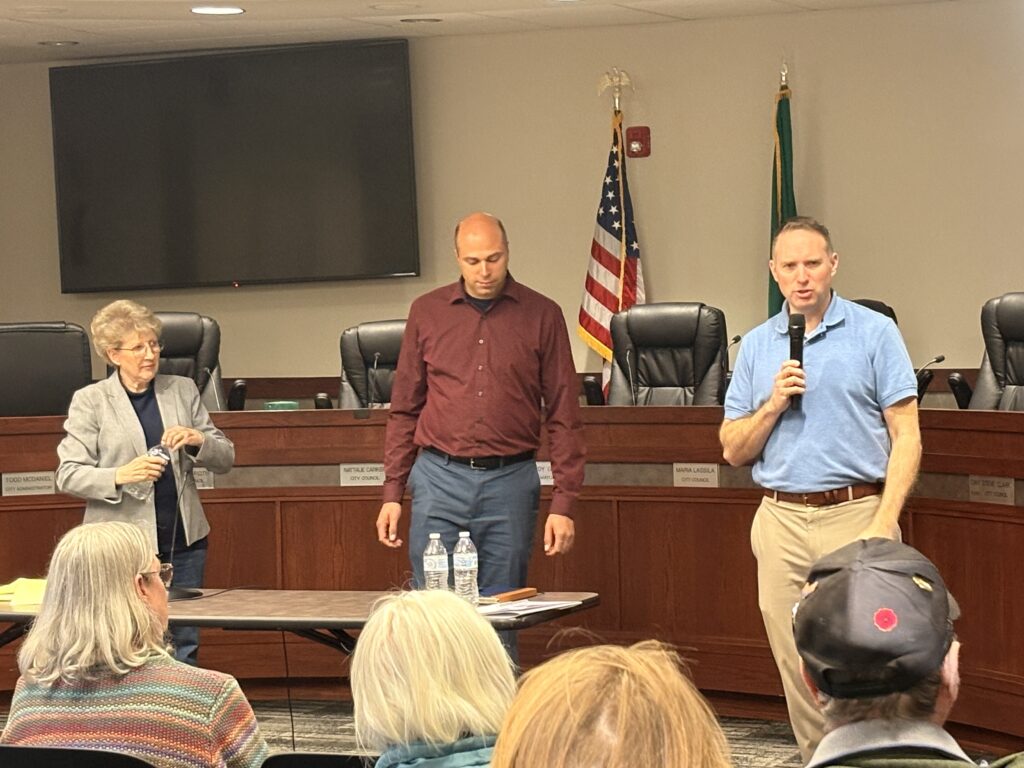
Local accountability for sheriffs, income tax, and availability of home insurance were the top issues at a town hall in Omak on Thursday where State Sen. Shelly Short and State Reps. Hunter Abell and Andrew Engell answered questions about the legislative session that ended March 12.
All three are running for re-election. Below are some highlights from the town hall.
Bill Allowing Removal of Elected Sheriffs
In response to a constituent’s concern about the governor controlling the highway patrol, national guard, and now, possibly, the sheriff if charges warrant it, Engell called Senate Bill 5974 “very offensive.” The bill would allow the Criminal Justice Training Commission, whose board is appointed by the governor, to remove sheriffs without the say of voters who elected them.
“The principle is terrible- that you would give unelected bureaucrats the ability to decertify their new sheriffs,” said Engell. “This is probably going to go to court. Hopefully, it gets overturned. We’ll see.”
Engell said it was driven by the desire to remove Pierce County Sheriff Keith Swank, although he told the audience he heard from a Pierce County representative that the county is moving to an appointment system for sheriffs, like King County did in 2020.
Abell also came out strongly against the bill.
“I can think of few things more destructive to public trust than allowing an unaccountable bureaucracy far away in Olympia to pick and choose the sheriff of Okanogan County,” said Abell. “I think that’s incredibly offensive to the voters here and very destructive to this concept of public trust that we work hard to try and build.”
Abell called the bill a “power grab,” in line with other bills such as the income tax and increased power for the state attorney general’s office.
The Washington Association of Sheriffs and Police Chiefs laid out their objections to the bill in a letter to Ferguson, asking for a line item veto of controversial provisions. Engell and Abel expressed doubt that Ferguson would apply a line item veto to the bill.
Short said unless Ferguson vetoes the bill, it’ll become law with or without his signature.

Income Tax
Senate Bill 6346 puts into effect a 9.9% tax on income above $1 million. It is pegged to the adjusted income on the federal income tax return.
The bill establishes a graduated income tax with an exemption for people whose income is under $1 million. According to Abell, if the bill is signed into law, the income threshold could be reduced by a simple majority vote in the state legislature.
Abell, a lawyer, asserted that a graduated income tax is unconstitutional under a 1933 Washington State Supreme Court decision, Culliton v. Chase, which affirmed that income is property, and property must be taxed uniformly. If there is a state income tax, it must be applied to all at the same rate.
The case was brought during the Great Depression, when 70% of Washington State voters approved the progressive tax. The state Supreme Court adhered to the state constitution.
Seventy-one people in the 7th Legislative District would be affected by the current tax, according to Abell. He said the Department of Revenue estimated they would have to hire 150 revenue agents to fulfill this obligation.
“Washington State will have its own IRS in order to implement and execute this income tax bill,” said Abell.
When asked by a constituent if the tax would benefit the district by taxing more people on the west side, Short countered that voters would not have a say in how the money is spent and it would not necessarily come to the district. She also noted that $2.3 billion of the $2.7 billion expected from the tax has already been allocated.
“What I saw in the building of the budget, that already spent $5 billion more than it took in, was Okanogan County didn’t win,” said Short. “If you talk about indigent defense and the things that our county [needs] to meet certain standards, desperate, desperate for help from the state to meet those standards because of the cost passed on to the county, not one dime. Not one dime went to that.”
Short said levy equalization funding, which helps poorer and rural school districts compete with higher property tax revenue districts, was cut.
“There is no guarantee that the money that comes into the state is going to be spent the way that you would like to see it spent in Okanogan County,” said Short.
Okanogan County Commissioner Jon Neal, who is running for re-election, commented that it was initially promised that 5-7% of the total amount of the tax would go to public defense, an unfunded state mandate that is hitting Okanogan County hard, but at the last second, it was withdrawn.
“So, we get less than nothing,” said Neal.
The sales tax exemptions that come with the income tax subtracts $200 million in income to counties, said Neal.
Home Insurance
Legislators heard complaints from the audience about inaccessibility to homeowner’s insurance. Rocky DeVon, a real estate agent in Oroville, said he can’t close on a sale when the buyer can’t procure home insurance.
“We had homes in city limits, with a fire hydrant in the front yard, that we could not get insurance on,” said DeVon.
“I haven’t seen a whole lot of movement from the insurance commissioner on fixing that,” said DeVon.
Short and Engell participated in a work group with the insurance commissioner that examined other states with wildfire areas. Short said she supported a bill that would have required insurers to provide transparency in determination of wildfire risk and provide credit for homeowners in areas mitigating the impact of wildfire, but it did not advance.
Short said it will be her “number one priority” in the next legislative session.
“That’s what insurance industries are- you’re in the risk business. You can’t expect homeowners and communities and businesses to bear all the risk,” said Short.
Neal, who also serves as a volunteer firefighter in Oroville, said the fire ratings bureau, which is run by insurance companies, calculates a rating score based on a fire district’s equipment rather than actual statistics.
“Our department has one of the quickest responses, lowest dollar per capita loss departments in the state, and we are barely maintaining a rating of six,” said Neal.
The rating system is one to 10. A one indicates exemplary fire protection.
“Basically, they do not care about any statistics. It’s the amount of equipment you have. We could go out and buy $10 million worth of equipment. It would all sit in a garage, and we could be a ‘1,’ and that is affecting all of your insurance rates. It has nothing to do with our coverage and our responses and our per capita loss,” said Neal.
Affordable Housing
Nancy Nash-Mendez, executive director of the Okanogan County Housing Authority, asked the legislators a general question about what they anticipated next year.
Engell said the state’s energy code has “dramatically increased the price of housing,” particularly for entry level, smaller houses than for moderate and larger houses, due to roof insulation requirements.
Engell said he will reintroduce a bill next year that would allow an exemption for small houses if a builder can demonstrate to the local code official that it would take an “excessively long time for meeting the code to pencil out in energy savings.” The local building department would have authority to approve plans under the previous code.
Wildlife
Short noted that the Fish and Wildlife Commission is under investigation for possibly using private computers and engaging in private meetings. Short said it will “sort itself out,” and talked about managing wildlife.
“I love our wildlife, and I want to make sure they do well and that we have populations that we can both enjoy to watch, to hunt, but I also want our ranchers and homeowners to have tools that we don’t have in this state.”
Agriculture
Short expressed support for Senate Bill 5117, sponsored by State Senator Ron Muzzall, that would require state agencies to note the effect of their policies on agricultural producers and minimize impact to agriculture. This provision already exists for small businesses. The bill did not pass committee this legislative session.
“The amount of regulation that we see coming down to our farm communities is insane,” said Short. “We want a clean environment. We want clean water. All of those things, but doggone it, the amount of regulation that has come down upon them is insane. It’s just insane, and we’re losing our generational farmers.”
“There’s going to be a lot more work in that space. Even though I don’t have a proposed policy right now, I would love to see Sen. Muzzall’s bill go through because finally, it would tell Fish and Wildlife, Department of Ecology, and probably DNR, look, when you look at doing things, you have to look at it in the eye of minimizing that impact, and I think that would be a first start.”
Rural Hospitals
Following an appeal by a constituent to consolidate insurance to reduce costs and criticism of the income of hospital CEOs, Christina Wagar, Chief Operations Officer at Mid-Valley Hospital and Clinic, said the hospital is writing off $5 million to $7 million annually in charity care, which elicited gasps from attendees.
“We’ve always lived on the edge. We’re used to living on the edge, but I think the edge is crumbling away from us a little more than we’ve been seeing the last 30 years,” said Wagar.
Wagar said rural hospitals’ costs aren’t less than urban areas.
“I still have to pay physicians what they think they’re worth. I still have to buy saline from the same vendors that they have to use.”
Wagar said she doesn’t know how funds for rural healthcare will be distributed by the healthcare authority following passage of the federal H.R. 1, or One Big Beautiful Bill.
“We still have no idea how that’s going to be given to communities or facilities. We don’t know if some of it is going to go to rural or metropolitan areas. We’re very concerned about that.”
“Every little incremental thing just feels like another piece of the cliff rock is falling away from us,” said Wagar.
Rank Choice Voting
A constituent asked the about the implementation of rank choice voting so that the county could have two strong Republicans to choose from instead of one from each party.
Engell said it’s a good idea in theory, but voter fatigue would make it a less accurate measurement for the district as a whole.
“I don’t have confidence that it would accurately reflect the majority of the voters’ desired outcomes. In theory, it’s good, but I just don’t think we’re ready to try to implement it and have it be accurate,” said Engell.
Abell said the system would be confusing to voters.
“It only really becomes a problem if you’ve got a plethora of candidates out there. So, in my mind, the answer is really not changing the voting system. Instead, try to engage in some sort of winnowing process to have fewer candidates running. I think there’s lots of ways to get involved in the political process rather than everybody filing for the same race,” said Abell.
When asked who would do the winnowing, Abell pointed to political parties, friends and families who would advise people to run or not to run.
Allowing Burials on Private Property
Abell sponsored House Bill 2239, which passed into law, that allows family burial grounds on private property, with some restrictions. Washington joins forty seven other states in permitting family burials on private land.
Abell said the law is especially important for farmers, ranchers and tribal communities.