
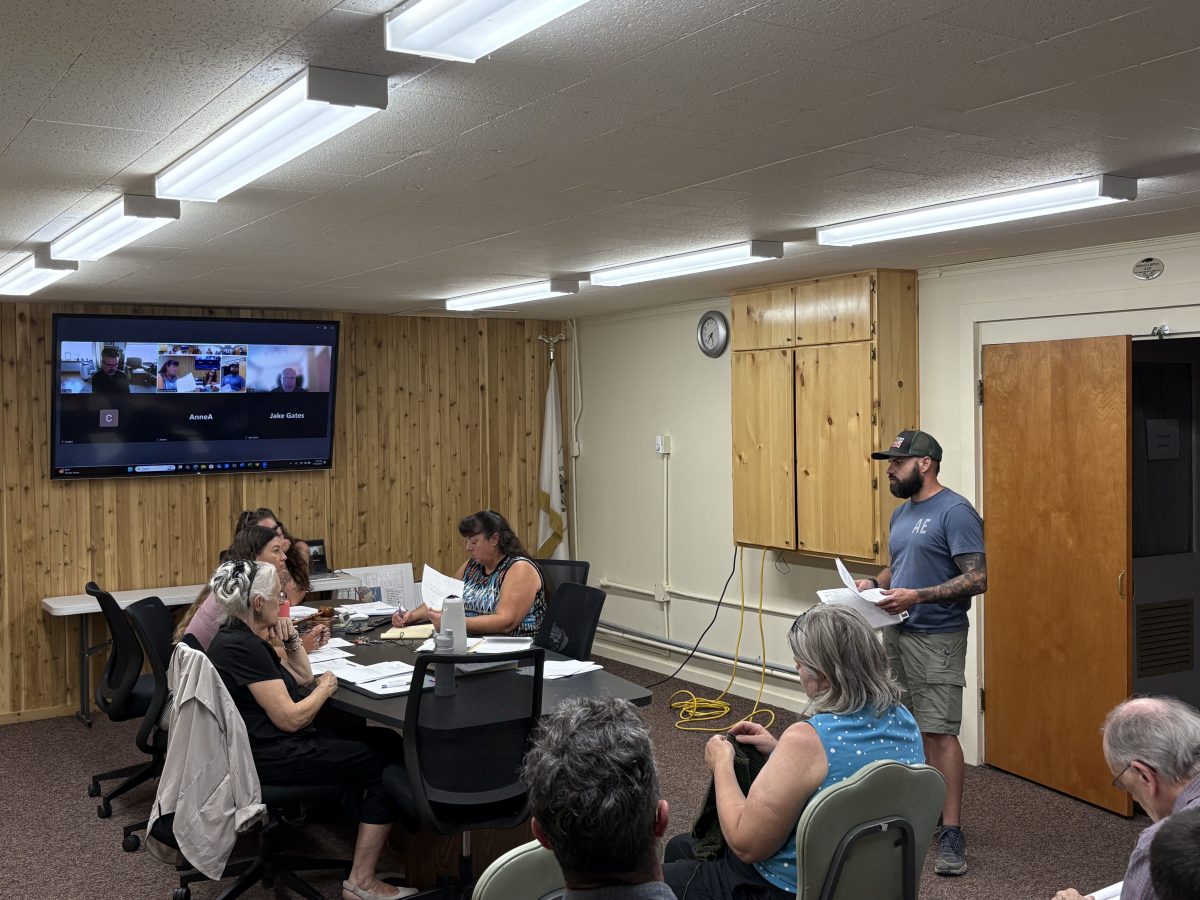
Sgt. Josh Petker of the North Central Washington Narcotics Task Force addresses Winthop Town Council members July 16, 2025. Photo by Julia Babkina
Getting your Trinity Audio player ready...

The North Central Washington Narcotics Task Force will request $50,000 each from Twisp and Winthrop to continue operating in the area, Sgt. Josh Petker told the Winthrop Council July 16. He will make a similar request to the Twisp Town Council.

This is an increase from $5,000 that each town is currently paying annually to the task force. Petker said the request will be formalized at the task force’s next board meeting on Aug. 4, where police chiefs, marshals, and sheriffs from member towns, cities, and counties are invited to participate. Petker said he is informing town councils in the region about the request that is coming.

Smaller towns such as Twisp, Winthrop, Oroville, Pateros, and Tonasket will be asked to contribute $50,000 to the task force. Larger agencies such as Omak and the Okanogan County Sheriff’s Office will be asked to pay $75,000 annually and supply an officer to be part of the task force. OCSO already contributes Petker to the task force.

“We will shut down if something doesn’t change,” said Petker. “We’ve got a little bit of reserve funding, but not a lot, so for the past two years, we’ve been operating on a deficit and only managed to continue with careful financial management and by utilizing a small reserve built from previous asset seizures.”

Petker did not mince words about the urgency of the situation: “Unless task force partners within Okanogan County step up, the North Central Washington Narcotics Task force will cease operations in the very near future.”

Low Profile, High Impact

The narcotics task force operates sting operations for high level drug trafickers. They handle about 45 cases a year with two detectives, an administrative assistant, and Petker, who supervises operations. Petker told the council that Winthrop’s police department lacks specialized training, resources and time to handle complex drug cases. Twisp does not currently have a police department and contracts with the Okanogan County Sheriff’s Office.

“The task force is the only plain-clothed detective division in the county dedicated to these types of investigations,” said Petker.

The task force also lends specialized equipment for investigations, such as hidden cameras.

Following the diversion of funds, Petker said the NCWNTF board unanimously decided not to rely on grants as the sole source of funding and moved to increase member participation fees. If towns and cities choose not to participate, the task force “will not operate within those jurisdictions,” said Petker.

Task Force Targeting Cartels

Petker said the task force is not arresting users, but cartel members, the majority of whom do not use drugs.

“That’s never been our focus and it can’t be with the size that we are,” he said. “We are always after the big supplier in this county who’s supplying the drugs. I’ll be as much of an advocate for any user there is, because I work with them on a day to day basis, and there is certainly not enough resources for recovery in this county.”

Petker said the informants he works with have told him they bring drugs across the Loup to the Methow Valley. He also said he receives intelligence every year about narcotic stops made in the Winthrop Park parking lot.

Last month, NCWNTF seized two pounds of methamphetamine, .55 pounds of cocaine, 11 grams of psychedelic mushrooms, and 15 firearms, including three that have been confirmed stolen, from a home in Okanogan.

“These seizures are not just numbers. They represent lives saved, weapons off the street, drug supply chains broken,” Petker told the council.

He said the task force doesn’t usually publicize their accomplishments because it doesn’t serve their investigative work, but he did so “because of our current state.”

“We usually don’t put a lot in the paper, and it’s just because of the nature of how we work,” he said.

Winthrop Marshal Ty Sheehan expressed support for the task force.

“It’s quiet and it’s behind the scenes, but it has a huge impact,” he said.

The Marshal’s office at one time contributed an officer two days a week to the task force. That cooperation ended when Sheehan became the Marshal, but that officer opened 11 cases in 2022, all in the Methow Valley.

“We’re just too small an agency to permanently have someone assigned,” said Sheehan, while acknowledging the task force’s importance.

“It made a big difference,” he said. “It’s not necessarily cases inside Winthrop, but it’s all the supply coming in. It has had an ongoing very positive effect for drug related crime, which is all crime, that we have dealt with.”

“The impact of the task force may not be as immediately apparent. It’s not raw numbers of arrests or particular incident numbers that you can track, but the overall effect that it has is substantial, and everything that makes its way to the Methow originates in Okanogan or Brewster. It’s all very interconnected,” he added.

Drug Overdoses Increasing in Okanogan County

While other parts of the country are seeing decreases in the number of drug overdoses, they are going up in Okanogan County. Petker reported 126 overdoses in the county so far this year. Last year’s total was 143. These numbers do not include overdoses that were not reported because the victim was revived in-house by someone administering Narcan.

This year, carfentanyl, a synthetic opioid, was found in Okanogan County, which is 10,000 times stronger than morphine and 100 times stronger than fentanyl. Petker said this is contributing to a rise in drug overdoses.

The task force has been in operation in Okanogan County since 1988 and funded by the federal Edward Byrne Memorial Justice Assistance Grant Program, also known as the Edward Byrne JAG program, which is administered by the U.S. Department of Justice. Washington’s Department of Commerce is the state administering agency for the grant. The grant is named after a police officer in New York who was killed in the line of duty by agents working on behalf of a local drug kingpin.

The grant is given to states to use for  personnel, training, equipment and supplies to reduce drug crimes and control the spread of illegal drugs. Washington State has traditionally used the money to fund 14 regional narcotics task forces in the state, of which NCWNTF is one.

“When it was first established… it served as a frontline in our fight against illegal drugs, narcotics, dismantling of drug trafficking networks, intercepting dangerous substances and holding defenders accountable,” Petker read from a prepared statement.

The Western States Information Network, which coordinates intelligence and provides specialized equipment and training to task forces in Alaska, California, Hawaii, Oregon, Washington, Canada, Guam, and New Zealand, recognized NCWNTF as Task Force of the Year in 2023 for what they were able to accomplish with a small number of officers.

That year, state legislators directed the Department of Commerce to divert the funds from the Edward Byrne JAG Program to social service programs, which had not been the intent of the grant, according to Petker. He said to his knowledge, Washington is the “only state in the country that is not using it for law enforcement, in terms of its intended purpose,” while acknowledging that the language in the grant is broad.

Locally, the money was used to start the CORE program in Okanogan County, which provides coordination between law enforcement and people with mental health, addiction, and homelessness. Petker said the $230,000 loss for their agency affects rural communities much more than larger counties, which can more easily absorb it.

Since then, NCWNTF has been surviving by conservative allocation of funds and cash seizures from drug raids, which by law have to be put back into drug prevention programs. Petker told MVE kingpins are increasingly relying on digital currency, making cash seizures harder. Tracking these funds requires a specialized detective, which NCWNTF does not have.

“Even in Okanogan County, we’re not far away from having to get electronic currency to buy drugs,” Petker told MVE in March.