
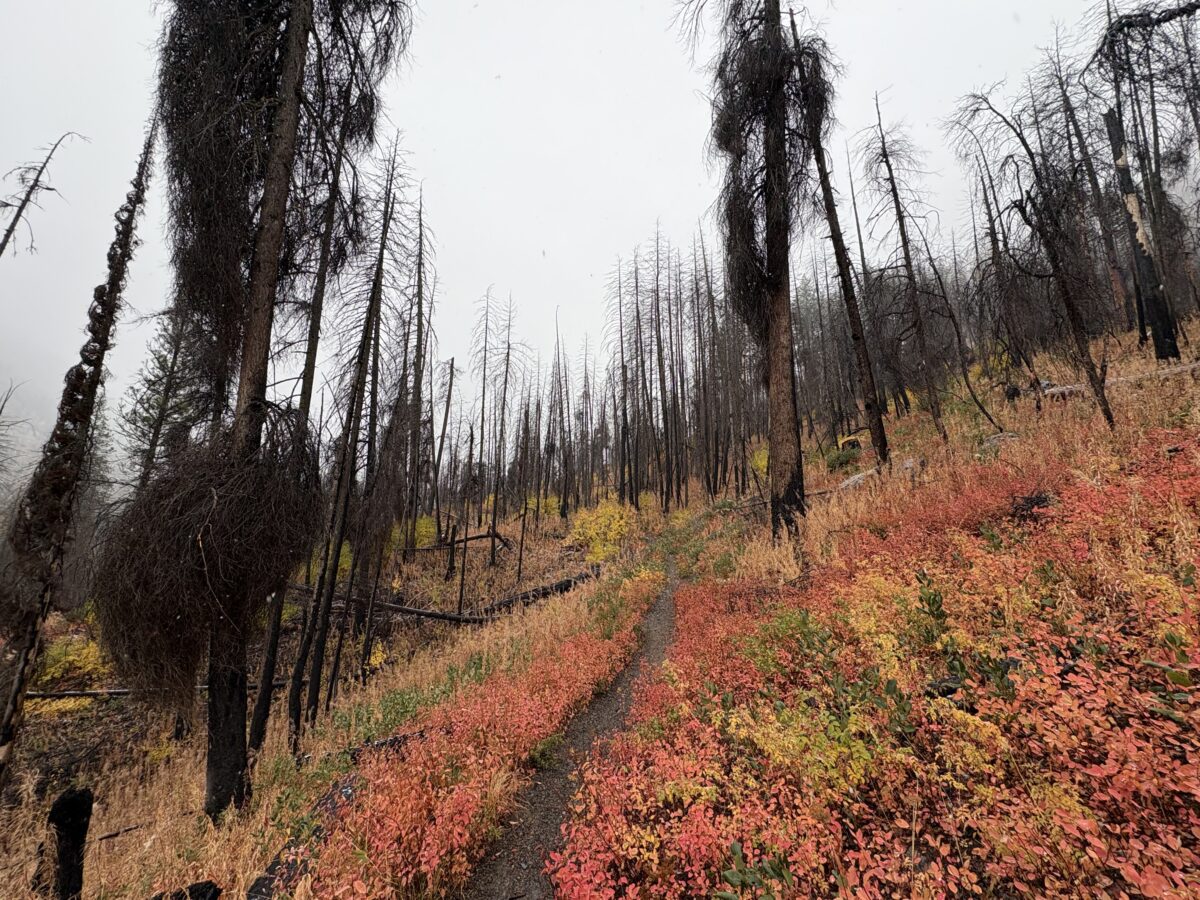
Cedar Falls Trail in mid-October. Photo by Julia Babkina
Getting your Trinity Audio player ready...

I have never been so complacent about hiking as I have since moving to the Methow three years ago.

When I lived in the city, if I didn’t get out to the “country” periodically, I would feel it. I’d become irritable, restless, anxious. Away from people, I regained my peace of mind.

Since actually moving away from people, I feel great all the time. I moved to a place with floor to ceiling windows that let nature in, so I live and breathe the outdoors, even when I’m indoors.

Tourists come here for outdoor recreation, but I haven’t participated in any of it. Last year, someone texted me if I was okay because my car hadn’t moved for a week. I enjoy immersing myself in reading, writing, and feeling the elation that comes from a work flow that makes time fly.

A person I know mentioned that in 50 years, he hasn’t been to any hikes around here either.

None.

In October, I decided to change that for myself. I challenged myself to four hikes in four days, enough to make a dent in exploring the natural scenery while still being manageable.

I got recommendations from the visitor information centers in both Twisp and Winthrop. I did not go to Hart’s Pass because I was told it’s gnarly to get there. (Les Schwab also told me to avoid it if I didn’t want a flat tire.) I didn’t want a super strenuous hike, but I didn’t want an easy one either.

None of these hikes lasted more than four hours. I wanted to test what someone could experience if they had half a day on their hands.

All of these hikes except one require a Northwest Forest Pass or $5 payment for parking. My personal belief is that charging people for parking as a requisite for hiking on public land is a symptom of misaligned priorities. (I also hoped that with the current administration’s budget cuts, patrolling tax paying citizens for $5 payments would be one of the first things to go.)

Without further ado, here are the hikes I embarked upon.

Day 1: Maple Pass Loop

Start of Maple Pass Loop. Photo by Julia Babkina

Maple Pass Loop is past Blue Lake on Hwy 20 and the farthest I went out of town. It’s near Rainy Pass trailhead at milepost 157. Either trailhead will take you on a 7.2 mile loop along a ridgeline, but I didn’t go that far because I started the hike around 3 pm. It was drizzling and cold, but as the old maxim goes, there’s no such thing as bad weather, just bad clothing. I pulled a sweatshirt out of the back seat of my car and headed out.

The Maple Pass trail is a bit steep for the first mile or so. Since the trail starts close to Hwy 20, the road noise follows you on the ascent, which, for me, defeated the purpose of the hike. I began resenting this endeavor until I saw a fork for Lake Ann. I knew that taking this detour meant I would see less of the main hike, but I decided to take it, and I’m glad I did.

Lake Ann. Photo by julia Babkina

There is a noticeably different energy on the path to Lake Ann. The trail is flat, a welcome reprieve, and I noticed the road noise had dissipated. I could still hear fragments of hikers’ conversations on the main path above, but with the road noise gone, I began to truly enjoy the hike.

On the way back from the lake, I saw a family of what I think are ptarmigans.

Photo by Julia Babkina

Back on the main path, I made it as far as the beginning of the ridgeline. Time wasn’t on my side (i.e. it was getting dark) and the drizzle that accompanied my journey began to turn into light snow. I didn’t have a proper flashlight and I used my phone, which was adequate.

On the return trip, I met a tourist from the west side who knew the trails around the region better than I did. An experienced hiker, she was prepared for the elements. She had a flashlight, waterproof jacket and waterproof hiking boots. She even carried a backpack. We walked back to the trailhead together because it was pitch-black by that point.

When I got back to my car, I felt my legs. They had gotten a workout. I drive a car with a clutch so I felt them even more.

Hwy 20 after a hike on Maple Pass Loop.

Pros: Lake Ann, a short hike that can be done in an hour, is worth the visit on its own. If you have more time, walking along the ridgeline is beautiful.

Cons: Road noise follows you the first mile of the hike.

Day 2: Cedar Falls

Burned trees from the Cedar Creek wildfire in 2021 stand in contrast to fall foliage. Photo by Julia Babkina

I learned about Cedar Falls from Cathy at the Visitor Information Center in Winthrop, who said it was her favorite hike. Those are some compelling words for me, so I put that on the list of my four hikes.

The first thing I noticed about Cedar Falls trailhead is that it’s quiet.

I liked it already.

Located 17 miles west from Winthrop, there is one sign on the right hand side of Hwy 20 if you are coming from Winthrop. Turn left on FR 200 and drive 0.8 miles to the trailhead.

The trailhead is farther from the highway than Maple Pass Loop, providing instant tranquility. There wasn’t anyone there on a Sunday at about 1 pm. I hiked for a couple hours and only saw another person when I was half way back to the trailhead.

The hike is less steep than Maple Pass, but still a hike. Instead of road noise, another hum grows omnipresent as you ascend the trail. At about the 1.75 mile mark, an unmarked turn to the left reveals the origin- the actual falls.

Cedar Falls in mid-October. Photo by Julia Babkina

I was more impressed with the beauty surrounding the falls than with the actual falls, but it’s worth the detour. It looks like something out of the movie “Blue Lagoon.” I didn’t go too much farther on the main path since it was meant to be an afternoon hike. My legs got another workout but I felt good about having two hikes under my belt.

Pros: Cedar Falls is a quiet hike punctuated by the rush of a waterfall that grows in vibrato as you ascend nearer.

Cons: The charred remains of a wildfire that went through the area in 2021 stand as a stark reminder of the devastation. I can only imagine what it was like with green foliage.

Day 3: North Cascades Trailhead

“Road Closed” and “No Trespassing” signs near the North Cascades Trailhead. Photo by Julia Babkina

I was actually looking for Early Winters Trailhead, but I couldn’t find it.

The standard-issue map provided by the town of Winthrop shows a loop across the highway from Freestone Inn. In its place, I found a campsite, but not a trail. So, I went back on Hwy 20, drove a few feet further, and found myself at the North Cascades Trailhead, which I only knew because of the map at the trailhead.

The first thing I noticed are the wide and flat trails, which were a welcome reprieve. My legs were aching by the third day. I began walking in one (flat) direction, only to encounter a barricade. I went in another direction and encountered a no trespassing sign.

I came across people walking their dogs, a few mountain bikers, and a driver in a Tesla, who was probably as surprised to see me as I was him. Everyone knew where they were going except me.

After being turned around, I found the Doe Canyon Spur, where I met a Native American Jewish Ukrainian retired marine who came from Forks for hunting season. He said that since Washington outlawed hounds to hunt cougars, their deer population dropped, so he came to hunt here.

He asked why I wasn’t wearing a hunting vest. I told him fluorescent orange isn’t my color. He said he would alert his hunting buddies that I was coming.

Doe Canyon is parallel to Hwy 20. While there was occasional road noise, I didn’t encounter anyone else on the trail besides the hunters. It was a beautiful fall day. I took off my jacket and tied it around my waist. My jacket is blue. I was now walking in a green sweatshirt, well aware that I was even more camouflaged.

When I got to the hunters’ campsite, I rested on a log off to the side. I saw two people with backpacks walking past. I called out to them and asked if there was another trail. They told me the trail ended, but the forest goes up to Canada. They warned me of hunters in the area. I wished them a good hike, at which point they mentioned the deer in their backpack. They mentioned several hikers had gotten in the way of their hunting.

I didn’t go into the woods. On my way back, my legs hurt. That night, I went to bed not feeling my legs, just my torso.

Pros: Free parking at the trailhead. Mostly quiet hike with flat, wide trails.

Cons: Avoid hiking there during hunting season.

Day 4: Blue Lake

Be prepared to encounter a gazillion people on your hike to Blue Lake. Photo by Julia Babkina

Blue Lake was on my bucket list from the start. I wanted to see what all the fuss was about. Mary at the Twisp Visitor Information center advised visiting the popular destination on a Tuesday for fewer crowds. It didn’t make much of a difference when I was there. Cars parked along the highway because the parking lot couldn’t contain all the vehicles.

Is it really worth the hype?

Absolutely, unequivocally, yes.

The trail to Blue Lake is a feast for the eyes. By mid-October, it was covered with a layer of snow that had turned to ice from all the foot traffic. I didn’t know there would be snow at Blue Lake in mid-October, but the tourists sure did. About 90% of them had poles and spikes on their boots. I was the dum-dum that didn’t have either.

I started the hike at 12:30 pm. There are some very icy patches on the trail. A burly hand of a Spanish speaker helped me up one slippery patch. The person that went before me crawled on their hands and knees. At another icy patch, a woman slid on her butt with the assistance of a passerby while her friend recorded it on video.

Blue Lake Trail is a feast for the eyes. Photo by Julia Babkina

Even with a gazillion people, there were pockets of stillness under the din of chatter. It was a clear, sunny day and I could hear my heartbeat in my ears.

It took me 1.5 hours to climb to Blue Lake. The views are spectacular. I rested there for 30 minutes, wishing there was a cabin to take in the scenery longer.

On the way down, I found myself in a conversation pocket. I actually enjoyed listening to it. The guy behind me found a real pole off to the side of the road and offered it to me to use. Even with a pole, I still chose to slide on my butt at several sections.

Pros: Spectacular scenery.

Cons: A gazillion people on the trail. Bring spikes for your boots and a pole. You’ll need them!

Conclusion

After four days of afternoon hikes, I felt a sense of accomplishment. I managed to get them in despite a busy schedule.

Was it challenging? Yes, but if you’re mind is set, you can do it.