
|
Getting your Trinity Audio player ready...
|

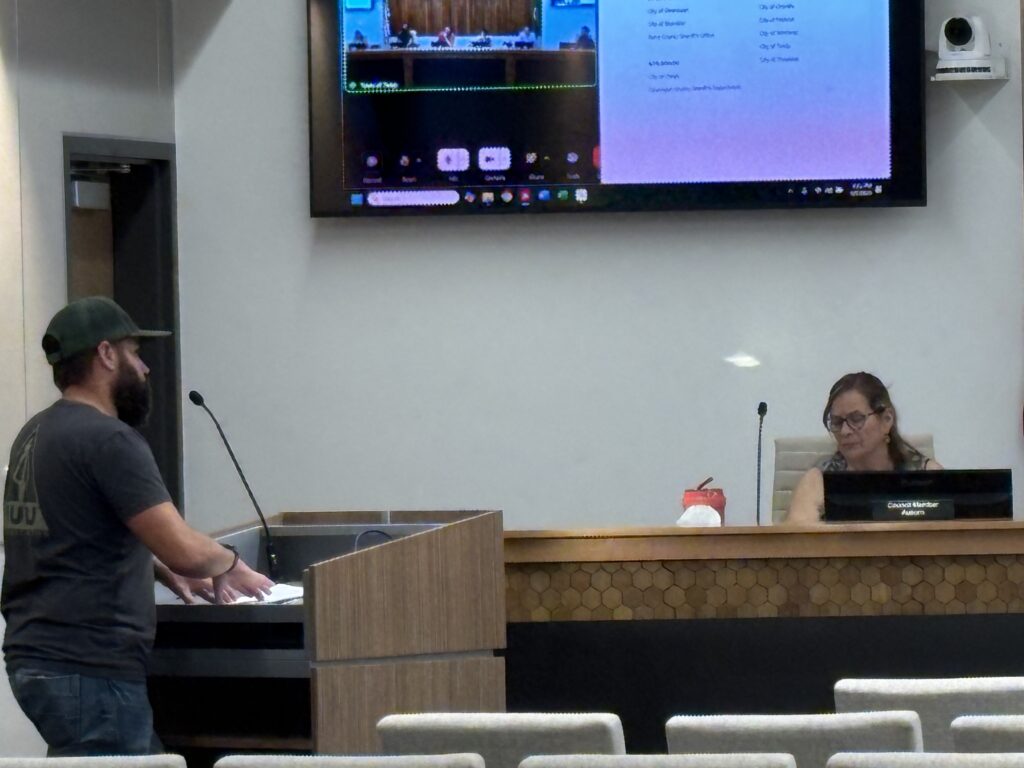
Sgt. Josh Petker of the North Central Washington Narcotics Task Force (NCWNTF) presented a dire choice to the Twisp Town Council on Sept. 9- the town needs to contribute $25,000 to combat narcotics trafficking and organized crime or it would cease operations in Twisp.
The fee is a decrease from $50,000 initially contemplated by the task force.
The situation arose two years ago after Washington legislators diverted federal funds from the Edward Byrn Memorial Justice Assistance Grant, which has historically gone to combat drug trafficking, to social service programs such as CORE (Community, Outreach, Response, Engagement), a behavioral health unit within the sheriff’s office. CORE focuses on treatment for persons suffering from addiction.
The state legislature supplemented about $150,000 from their general fund to aid the task force, but that ended on July 1. NCWNTF has operated on a reserve, but that is running out and is no longer sustainable, said Petker. The Edward Byrn Grant allowed the task force to keep member contributions low, but with the funding diverted, the cost is passed to towns and cities.
Petker said the state’s diversion of funds will affect rural communities the hardest because larger cities can more easily absorb the cost.
Cost Increasing for All Participants
Winthrop will also have to pay $25,000 to participate. Twisp and Winthrop had been paying $5,000 annually. The Okanogan County Sheriff’s Office and the City of Omak are expected to contribute $75,000; Cities of Okanogan, Brewster, and the Ferry County Sheriff’s Office are expected to contribute $50,000; and the cities of Oroville, Tonasket, and Pateros are also expected to contribute $25,000. The fee needs to be paid by Jan. 15, 2026 to receive services from Jan. 1 to Dec. 31, 2026.
Omak will also be required to contribute a full time officer to the task force, as the sheriff’s office is already doing. Petker said he applied for three grants so far, including $300,000 the county received from the opioid settlement fund, but the county commissioners did not allocate it to the task force.
“I talked to the commissioners about this, because I think county was one of the first places I visited. They were saying, ‘Well, we don’t know if we have the money,’ but you had the money,” said Petker.
Criminals Adjusting to Lack of Police Presence
Petker said criminals have already taken into account the lack of a police presence in Twisp.
“There are active drug dealers, one particular, that moved over here within the last month because of the lack of law enforcement in this area. That’s not meant to scare anybody, but if you lose the task force, that’s going to happen county wide.”
“If we do not get support from the cities, we will be closing our doors, and that is what concerns me more than anything is losing the task force,” said Petker.
Petker said pills with child-friendly sounding names like “Skittles” are designed to attract children. The drugs are so powerful that they can kill an adult with a single dose.
“This isn’t a pitch for me to stay so that I can stay in the task force, because at the end of the day, I don’t lose my job. I go back to work patrol, probably have less stress, probably better home life, in all reality, but I’m here because I think this is important. I’m raising children here and it concerns me the day that this county does not have somebody that is enforcing drug crimes,” he said.
Supply and Demand Problem
Petker said he supports treatment for addicts, but the supply must also be addressed. The task force averages 48 cases a year with only two full time detectives. Some investigations take years working undercover and all take expertise, which the general police force doesn’t have.
“I’ve been working law enforcement in this county for 18 years now. I get new guys in that have significant patrol experience, and they’re blown away as to the step they have to take to start working narcotics. It’s a totally different type of police work,” said Petker. “These seizures that I’m talking about, they’re not just numbers. They represent saved lives, weapons off the street and drug supply chains broken.”
“People need to understand, we don’t put a lot in social media and the media, and there’s a reason for that. When we do that, including these last stories that have come out, it’s a negative for us. We’ve got suspects that are on the run, and now we’ve kind of tipped our hat as to who we’re looking for, and it’s just never a positive, because our investigations are never complete,” he said.
There have been 126 police and ambulance calls in the county involving overdoses as of June of this year, and increase from 64 for the entirety of 2020.
Twisp Council to Deliberate
Councilmember Katrina Auburn said she would support funding the narcotics task force, acknowledging that there have been overdose deaths this year in the valley and in Twisp.
“It is alarming for the town of Twisp. We’re small, we are very vulnerable right now, and I think that is real. That’s not just a fear mongering statement,” said Auburn.
Petker responded, “If there isn’t any active law enforcement working on this stuff, it could look like the streets of Seattle here. I don’t think any of us want that.”
Councilmember Tim Matsui questioned whether the town can afford to spend $25,000 on the task force.
“I’d like to creatively be in support of you getting state or federal funding back for this,” said Matsui.
Twisp Mayor Hans Smith asked if the fee structure was premanent and could be adjusted. Petker said even if the grant was restored, the fee structure provides longevity to the program. If one town doesn’t pay or pays less and still wants services, it may get pushback from other towns that did pay the full amount.
The Edward Byrne Memorial Justice Assistance Grant Program, also known as the Edward Byrne JAG program, provides grant funding to cities and towns across the U.S. to combat drug trafficking. The grant is named after a 22-year-old police officer in New York who was killed in the line of duty by a local drug kingpin. The task force has operated in Okanogan and Ferry Counties since 1988.
NCWNTF combats high level narcotics trafficking, organized crime, and related criminal activity, such as stolen weapons. It does not target low level users. The task force is governed by a board of directors consisting of the chiefs of police of each participating town or city and Okanogan and Ferry County prosecutors. The board sets the investigative priorities and meets at least four times a year. Petker presents to the board the number of arrests and the amount of drugs seized by the task force.
Twisp is represented by Okanogan County Sheriff Paul Budrow since the town contracts with the sheriff’s office for services, but since each board member can only cast a single vote and Budrow represents two jurisdictions- Okanogan County and Twisp- only a single vote is cast for two jurisdictions.
Smith said the request for funding will be discussed in the Public Safety Committee. He also said Sheriff Budrow will be at the next town council meeting on Sept. 23 to talk about the narcotics task force. The town council meets the second and fourth Tuesday of the month at 5:30 pm in the Twisp Civic Building.


