
|
Getting your Trinity Audio player ready...
|
There is more unknown about photographer Frank S. Matsura than there is known about him. That’s one take away from a new independent film about the Okanogan County photographer called “Our Mr. Matsura” by Vancouver, Washington-based filmmaker Beth Harrington.
Japanese-born Matsura was virtually a household name in Conconully and Okanogan, where he lived and worked from 1903 to 1913. When he died unexpectedly at age 39, three hundred people attended his funeral, a number never seen before in the county.
An article published June 20, 1913 in the Okanogan Independent on Matsura’s untimely death read, “…Frank Matsura was a gentleman in every sense of the word. He held the highest esteem of all who knew him. He was one of the most popular men in Okanogan and was known from one end of this vast county to the other….”
This time next year, he’ll be introduced to the country in Harrington’s new documentary, “Our Mr. Matsura,” which was just accepted by National Educational Telecommunications Association (NETA) for distribution to local public television stations. (The film had been under consideration for PBS’ American Experience, but after the rollbacks in federal funding, that program will cease to broadcast, after 37 years, at the end of this year.)
“The current circumstances are affecting every part of film distribution. Festivals that used to get NEA (National Endowment for the Arts) and NEH (National Endowment for the Humanities) money have to reduce programming, for example, but we will prevail and get this film seen!” Harrington said in an email to MVE.
“I’m excited they decided so quickly,” Harrington said about NETA’s acceptance of the film for distribution. “Usually, they take as much as three months to accept or reject a film. They chose “Our Mr. Matsura” right away, which says something.”
For all of Matsura’s admirers, their parting gift has an oversight. His tombstone bears an incorrect inscription- that he died at age 32, not 39.
“We aren’t sure why the tombstone says 32 years old,” said Harrington. “He was definitely born in 1873, which would make him 39 at the time of death. We believe Judge [William Compton] Brown paid for the stone so we’re not sure why someone so close to him had the wrong age. Again, many unanswered questions about Frank.”
Leaving Home
Frank was born Sakae Matsura to a prominent family of samurai ancestry, but by eight, he was an orphan. He was raised by his aunt and uncle, Christians who founded a church and a Christian school for girls, where Matsura later worked, in Tokyo. Matsura was fluent in English and self-identified as Christian.
He kept a diary for only a short period in his life, between the ages of 19 and 21. He kept secrets from his diary. There is no indication he wanted to leave Japan, but one day in 1901, without telling his family or friends, he boarded a steamship in Yokohama Harbor for America, never to return.
His voyage wasn’t unusual. Many Japanese, including his own extended family, traveled and returned from the U.S. Postcards, in some cases addressed to him only by name, county, and state, reveal that his family and friends missed him. After arriving in Seattle, he made his way to Alaska, then to Conconully and finally, Okanogan, where he made his home.
He lived with tuberculosis, but his own death on a Monday night came as a surprise to him. He succumbed to his illness while hurrying on an errand for the Okanogan town marshal. He fell on a porch on the way and reportedly said, “Oh, I am dying.”
One hundred twelve years later, what’s left is a tapestry of his photographs but little about the internal workings of a man who led such a remarkable life in a short period of time.

Documentarian and Artist
Matsura photographed Okanogan County through the lens of a Japanese photographer. He was a third party documenting American history, but we don’t know what he thought about it. We can only infer from his photographs.
At a time when photographic images were still new for some people, his subjects trusted him. Some sat straight, some slouched. Some looked uncomfortable, some looked bored.
He photographed Chiliwhist Jim, Chief of the Okanogan Indians, riding in his regalia through Second Avenue in Okanogan. He sits bareback on a horse, seemingly oblivious to, or perhaps purposefully ignoring the stares of the onlookers. The white men around him don’t seem to know what he’s doing there. Chiliwhist Jim could turn around and ask them the same question-what are you doing here? But he doesn’t. He exudes pride, confidence, but who knows what he’s thinking.
Who knows what anyone is thinking.

Matsura was equally comfortable with white settlers. He didn’t take himself too seriously. He stood comfortably next to white men who were head and shoulders above the fully grown Matsura. He photographed playful scenes with young white women who clearly enjoyed his presence.
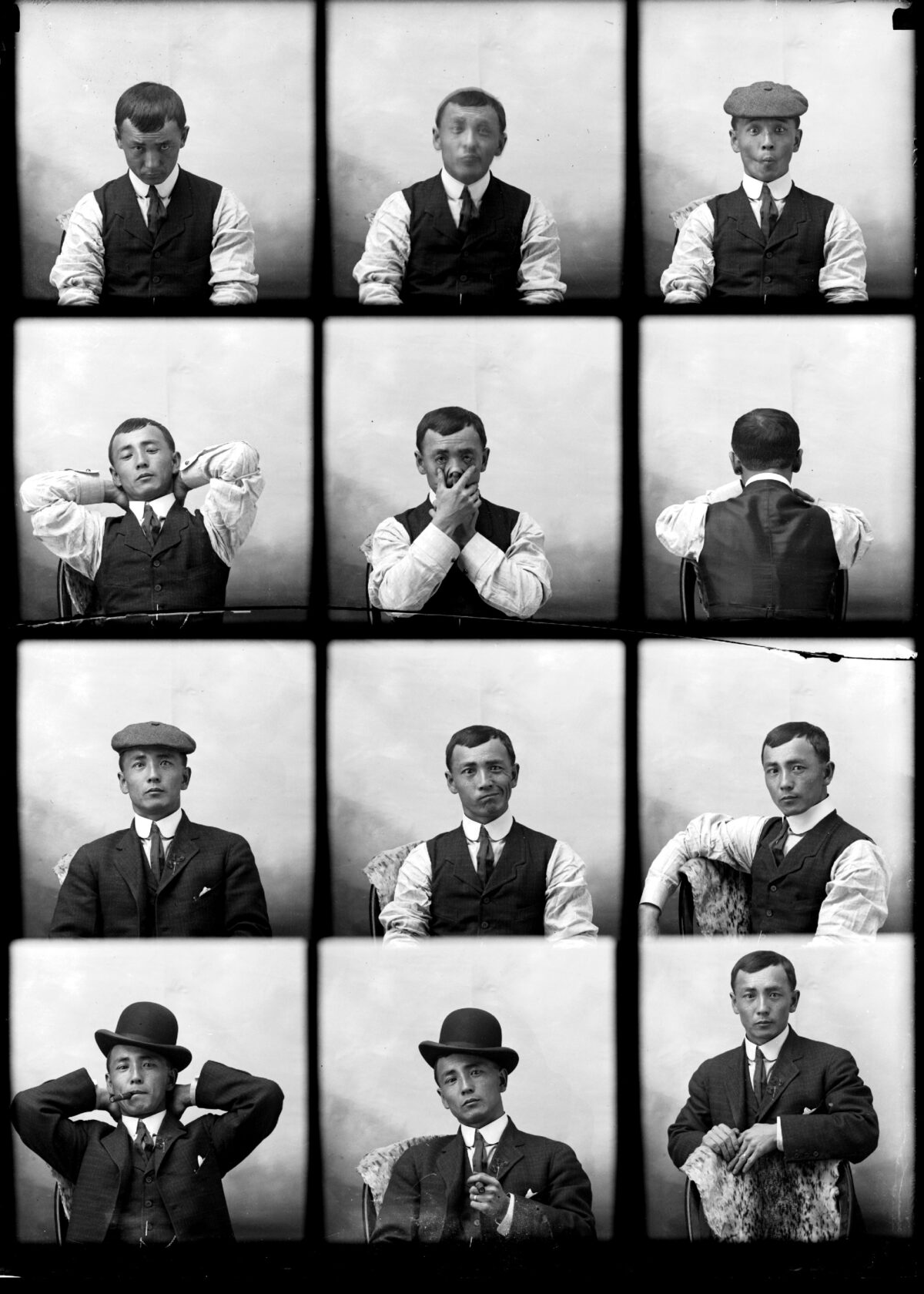
Matsura mixed with people that didn’t mix with each other. He had fun with his subjects, often posing with them. His unconventional approach to photography was something he learned in the Asakusa District in Tokyo, which Matsura wrote about in his diary. There, it was popular to photograph not just the person, but various iterations of the person. As one interviewee in the film put it, photography in that district wasn’t just photographing who one is, but who one could be. Photographers captured images of people in costumes with surreal or mythical props to explore the boundaries of those possibilities.
Matsura brought these ideas to Okanogan, pushing the boundaries of convention at the time. He didn’t care if the drape behind his subjects was uneven or revealed camera equipment. He wasn’t afraid of wasting film on silly photos and even welcomed them. Matsura experimented dressed as a clown, wearing costumes and silly hats, and trying to capture motion, which was extremely difficult with the technology at the time.
Matsura personally knew many of the people in his photographs, which contrasted with a documentary-style approach that many of his contemporaries applied to photography. By the early 20th century, the price of a photograph might still require someone to save to purchase one, but it wasn’t out of reach for the common person.

Matsura was a bridge between Native Americans and homesteaders because he could relate to both. He could identify with the values of the Christian homesteaders, but also likely found similarities between Native American spiritual beliefs and Shintoism in Japan.
A eulogy by Reverend Fred J. Hart, read in sections by participants in the film, beautifully encapsulates the man that many saw, but few really knew.
Frank came to our country from Japan a stranger. Just as Joseph went forth to live among strangers centuries ago in Egypt, Frank came to live in our country. When he came to our midst, he left his native land, his customs, his friends, his people far across the sea, choosing to cast his lot with us. Like Joseph, Frank became an excellent citizen of his adopted country. He was one of the most useful men in our community. Not a man or woman in town but mourns his loss. Even the little children will miss him.
We recall with pleasure his deeds of kindness and we like to remember that life in our town was brighter and better for his presence. How would it have been if we had known that Frank was to leave us at this time? Perhaps we could have tried to be a companion to him in his loneliness. For at times, he must have been lonely, thinking of friends across the sea. Perhaps someone might have said to him, “I admire your cheer and your industry, and I am a better man because I have known you.” Or we might have spoken to him more intimately of his soul, and the things that lie in the great beyond, where he is now. Whenever a friend or an acquaintance is taken, do we ask ourselves these questions- have I helped him all I could, or have I hindered him? Have I taken the things he had to offer me, and am I better for them?
As Joseph was buried in Egypt, so we must bury Frank, far from the land of his birth. Perhaps Frank, with his Japanese love of the beautiful, would rather be buried in his own land across the seas. Or perhaps he would prefer to lie here, where he has lived and worked. Who knows? All we can do for him now is to love and cherish the memory of the man whose place cannot be filled, and then let us so live that when God in his infinite mercy and wisdom calls us to the other side, we may again meet our little Japanese brother, who has gone on before.
Matsura is buried in Okanogan City Cemetery. His close friend Judge William Compton Brown donated his photographs to the Washington State University Archives. After Brown’s death in 1963, several boxes of Matsura’s glass negatives were discovered in his garage. These were donated to the Okanogan County Historical Society. WSU has about 1800 Matsura photographs and the OCHS has over 3,000 images, including glass and film negatives.

Descendants in the film clutch family photos taken by Matsura. To honor their participation in the film, Harrington held a few screenings locally in September and October.
She just signed a theatrical distribution deal with Argot Pictures in New York City, which will begin working this spring to get the film shown in art house cinemas around the country.
A spokesperson for the Shafer Historical Museum said they might be able to reshow the film next spring.
For more information about the film, including additional photographs, visit ourmrmatsura.com.
To be notified of upcoming events at the Shafer Museum, email [email protected] to join their mailing list.
For a walking tour in Okanogan of murals and photo displays of Matsura’s work, visit here.
For an audio walking tour in Okanogan of murals and photo displays of Matsura’s work, visit here.

If you haven’t seen Beth’s film on Frank Matsura, make sure to do so. I enjoyed it so much I attended a second showing!!
There is a lot to absorb in the documentary. I watched it again too.
A very poignant article about an interesting character, a part of local history. Thank you for sharing this story.
Thank you : )