
|
Getting your Trinity Audio player ready...
|
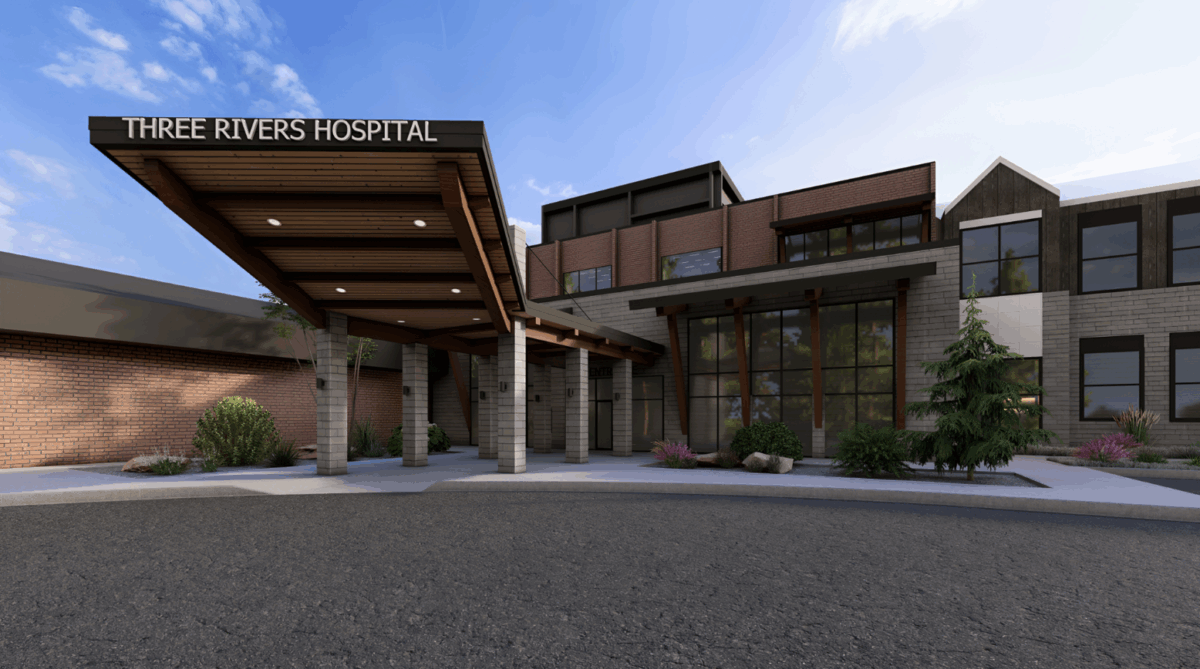
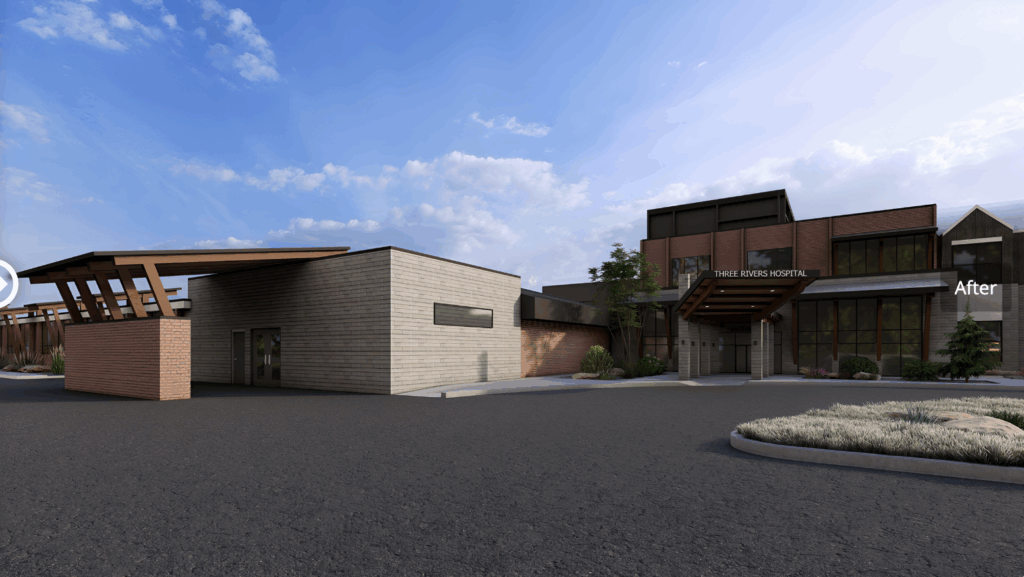
Ty Witt, Chief Medical Officer and a surgeon at Three Rivers Hospital, presented a $45 million plan to Twisp and Winthrop Town Councils in September to renovate sections of the hospital that deal directly with patient care- inpatient, surgery, lab, radiology, the entrance, and the emergency room.
The levy, which will be on the ballot this November, will also include upgrades to plumbing, electrical and a new boiler and generator for the 76 year-old hospital. The renovation is essential, said Witt, as modern equipment becomes larger and requires more electricity.
Three Rivers is spending over a million dollars annually on fixing things in the building. A renovation would not only improve service to patients, but make sense financially, said Witt.
“The problem with some of our equipment is that you can’t get parts for it anymore, as you can imagine. They have to be manufactured by a guy that can somehow figure it out.”
He referred to two people who make things work in the hospital as MacGyver I and II.
“We spend a lot of our operational money just to keep the building going when that money should be going directly to patient care. I think this bond is going to save us money operationally and make us even more solvent than we are now,” said Witt.

The levy would also enable the hospital to move the helipad to the roof. Its current location, between a building, electrical lines and a cliff, makes pilots nervous, according to Witt, especially when it’s windy or in bad weather.
A $75 million bond levy proposed two years ago that would have renovated the entire hospital received only 43% of the vote. Witt said the hospital spoke with people who voted against it and learned they weren’t against the hospital, but the cost.
The new proposal costs $30 million less and limits renovation to parts of the hospital that interface with patients. Three Rivers is calling this a “hybrid renovation.”
The levy up for a vote in November would assess 78 cents per $1,000 assessed property value for 30 years in Okanogan Douglas Hospital District 1, dba Three Rivers Hospital, which, in addition to the Methow Valley, serves Brewster, Bridgeport, Mansfield and Pateros. It needs 60% of the vote to pass.
Concern About Hospital’s Financial Footing
Peter Morgan, a valley resident who has worked in healthcare for 40 years as an analyst, manager, executive and board member, told the council he opposed the measure.
Morgan said that counting Lake Chelan, there are four regional hospitals within 78 miles of each other “all with fragile staffing, fragile finances competing for patients and staffing, and now tax dollars to stay viable.”
“This is a particularly dicey time to be running a hospital, never mind building a new one,” he said. “Our healthcare system got a boost under Obamacare with the expansion of Medicaid and the healthcare subsidies and tax credits that it provided. The current federal plan is to roll that back to pre-Obamacare levels that will really threaten the viability of our hospitals.”
“The question I think we should ask is, if there was no hospital in Okanogan County and you had to start from scratch, what would you build? I don’t think we would build what we have today, and therefore, without even asking the question, I don’t think we should rebuild what federal government built with our own tax dollars.”
Morgan said when Three Rivers asked the voters for a levy two years ago, a group of rural health care professionals and lawyers formed a planning group with Okanogan County’s three hospitals to look at consolidating to optimize cost, quality, and access. Morgan said Three Rivers is asking for money before that process has played out.
Valley resident Mel Sorensen, a lawyer who specialized in healthcare policy and financing, also stated his opposition to the proposal. Sorensen questioned the hospital’s financial health, citing an article in the Quad City Herald that said the hospital only had days in financial reserves.
Recent changes to Medicaid, which is widely expected to decrease enrollment due to new paperwork requirements, will exacerbate the problem, said Sorenson, because so many people in the region receive their care through Medicaid, hitting the hospital’s bottom line.
He also said patient admissions of “two per day or less, some days zero” are too low to support a hospital, and the biggest concern is the bill voters would still have to pay if the hospital fails.
“If the hospital fails after the people have passed the bond issue, the people will get to pay 30 years of property taxes and have no hospital services for which they passed the bond.”
Sorensen said he supports a larger discussion about combining resources for a regional hospital.
Large Regional Hospital Not Workable, Says Three Rivers
Witt said a regional hospital isn’t workable because of the size of the region. There isn’t a good location, said Witt, because anywhere you put a hospital would be an hour or more away for some residents. Three Rivers is essential for emergency care in the Methow, said Witt, especially when snow and ice make driving over Loup Loup pass hazardous.
With regard to finances, Witt said many hospitals are struggling, including Confluence, UW “sometimes,” and hospitals in Spokane because of insurance reimbursements.
“All hospitals struggle financially,” said Witt. “I’m here to personally testify that Three Rivers Hospital is growing in volumes and our financials are better than they were 10 years ago and are continuing to improve.”
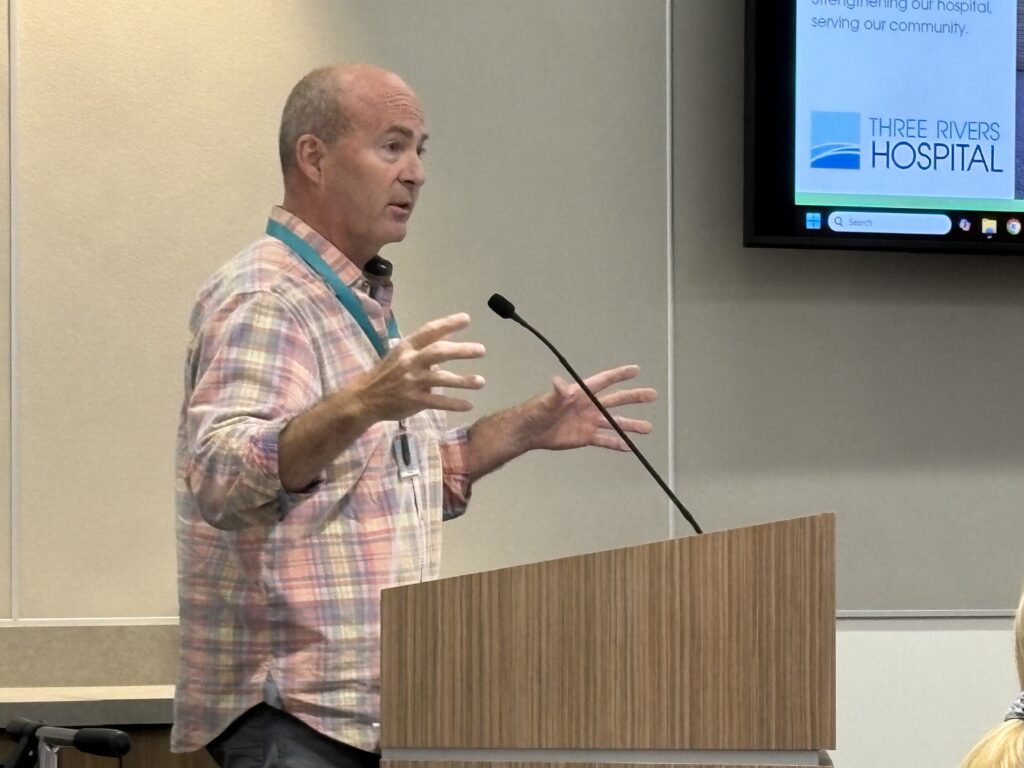
Three Rivers sees over 4,000 people in their emergency rooms annually, which Witt sees as the most important function of the hospital because it provides critical, time sensitive care, particularly to stroke and heart attack victims who need medicine within 20 to 50 minutes.
Three Rivers isn’t allowed to keep a patient in a hospital for more than three days. If additional care is needed, the patient is transfered to a larger hospital.
“We have lots of doctors and lawyers and professionals that support this structure. This isn’t an outdated system. It saves lives in rural America. The downside is it takes tax dollars to do it,” said Witt.
The hospital also serves 10,000 patients annually in their primary care clinic, which Witt said is essential for indigent people for whom transportation to the west side or Spokane is prohibitive. The hospital performs full service mammograms, echocardiograms and CT scans.
While the wait for an echocardiogram at Confluence is four to six months, the wait at Three Rivers is two to three weeks with “one of the best people in the state to do it,” said Witt.
“Critical hospitals are not supposed to have sick, sick patients. We don’t have an ICU. We don’t have all the specialties that are there. We don’t take care of everybody with everything. We have transfers that are set up to the university centers and the transfer centers throughout our state. That’s what we use.”
The hospital does have swing beds for people rehabilitating from surgeries, such as hip surgery, or following a stroke.
“We keep patients in the hospital to help with their recovery, where they’re not quite ready to go home, but they don’t need to be in a tertiary care center.”
The hospital does perform general surgery for appendix and gall bladder and handles orthopedics, boken bones and fractures, 90% of which can be handled in-house.
Witt challenged both Morgan and Sorensen to a debate and said he is willing to talk about the hospital with anyone and with any group. Three Rivers has been engaging in outreach by presenting the details of the upcoming levy to towns and cities in the hospital’s district.
Approval would mean a year to a year and a half of planning and permitting. Construction wouldn’t begin until August 2027, finish in October 2028, and occupancy in December 2028.
For additional information, visit https://threerivershospital.net/hybrid-renovation/ and https://www.facebook.com/ThreeRiversHospital/
Leave a comment


Thank you for these thoughts!
You’re welcome. : )